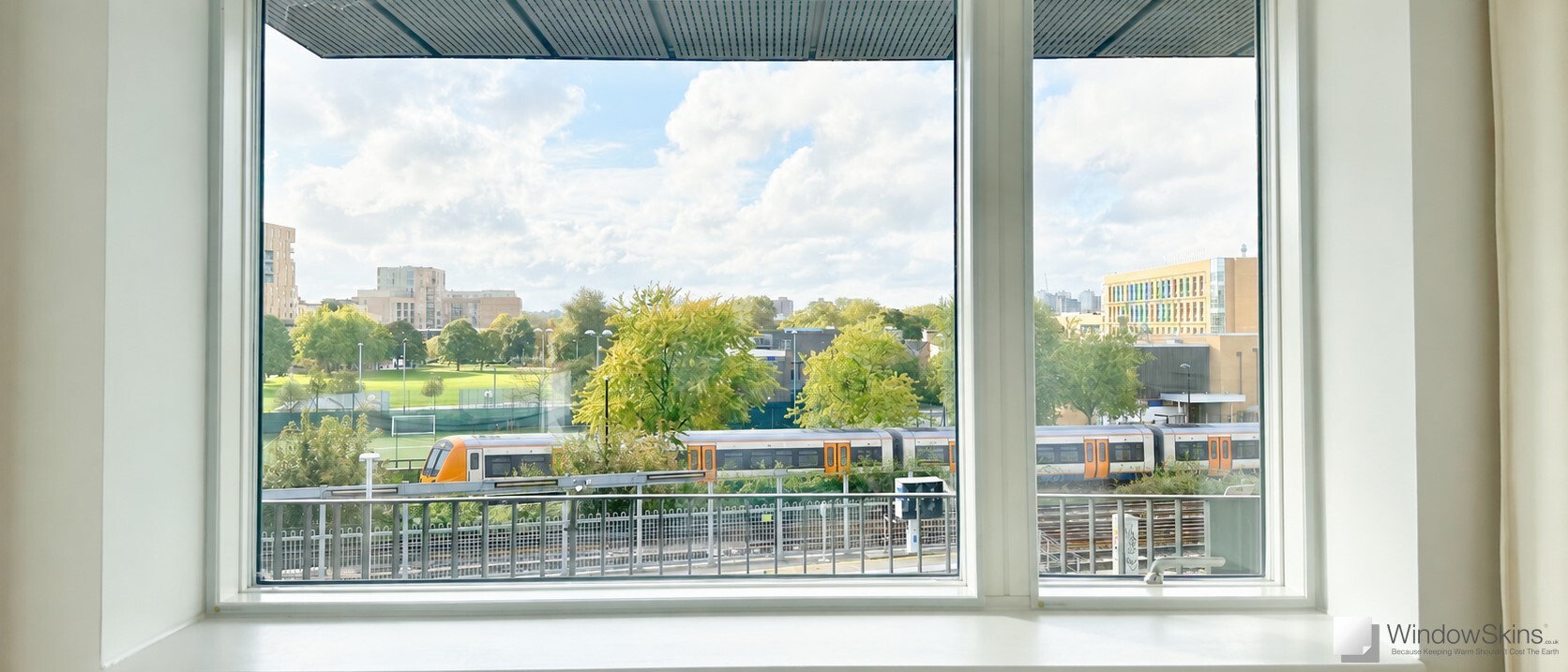
How to reduce outside noise through existing windows — and prevent sound escaping from inside
Windows are often one of the weakest parts of a building when it comes to noise. Sound can travel through the glazing, through gaps around opening sections and frames, through ventilation openings and, to a lesser extent, the window frames itself.
Effective window soundproofing therefore isn’t simply a matter of adding more or thicker glass.
Secondary glazing can be particularly effective because it creates a second, independently separated barrier while also providing the opportunity to create a much larger air gap than conventional double glazing.
Why Noise Through Windows Matters
Excessive environmental noise is not just an annoyance, but is also associated with negative health effects related to sleep, concentration and stress. This can significantly affect performance at work or home, affecting overall relaxation and wellbeing.
Improving the acoustic environment of a room can materially improve how comfortable that room is to occupy.
Modern living in busy urban environments can make a peaceful home difficult to attain – typical sources of noise pollution include :
- Aircraft
- Trains
- Road Traffic, Buses and HGVs
- Voices and Pedestrians
- Schools and Playgrounds
- Pubs, Clubs and Restaurants
- Loud music
- Machinery and Construction
Dealing with these sources of noise pollution can be time consuming, stressful, and more often, ineffective.
The WHO identifies environmental noise as a significant environmental health issue.

How Does Sound Get Through a Window?
Sound passes through a window in three ways :
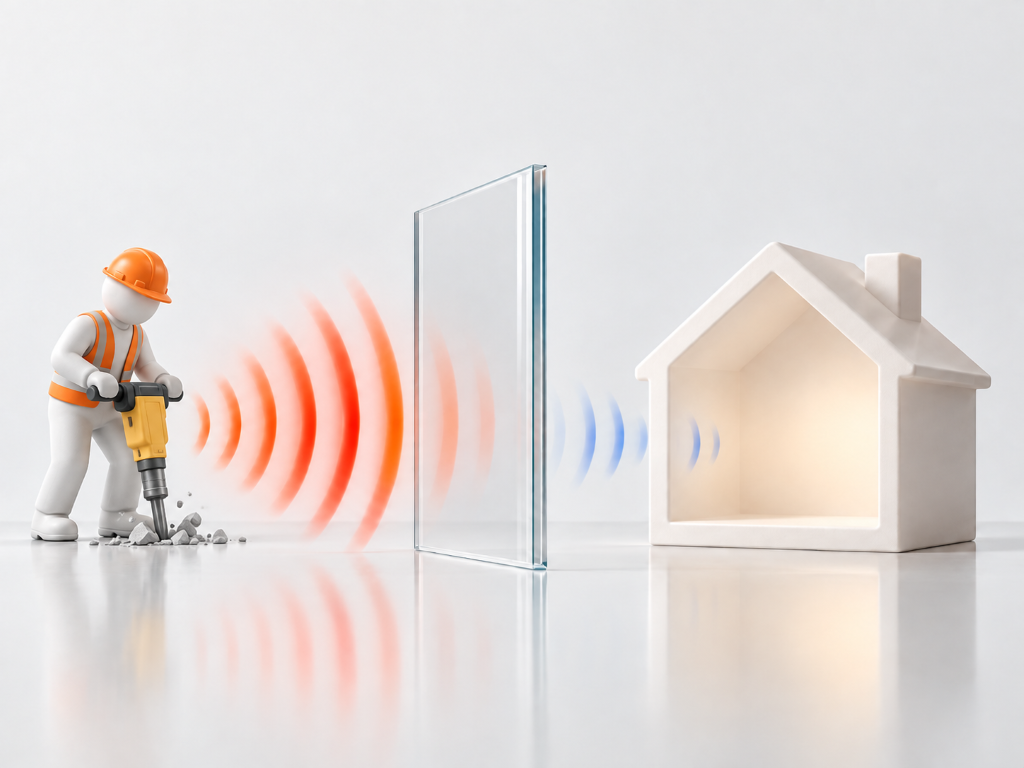
Through the glass – airborne sound reaches the glass and causes it to vibrate. The vibrating pane then radiates some of that acoustic energy into the room.
Through gaps around the window – sound follows air pathways extraordinarily well. Poorly sealed windows can seriously affect noise reduction performance. Whilst seemingly obvious, this is easily overlooked.
Through the frame – sound isn’t just transmitted through the glass, but also the frame, albeit to a lesser extent.
Additionally, as part of a noise reduction strategy, one should also consider how much sound is entering by other means, primarily via the walls, floors, ceilings and doors.
Acoustic Properties – Decibels and Frequency
It is (relatively) common knowledge that sound travels as waves. The two core properties (or characteristics) of these sound waves are decibels and frequency.
Decibels – dB(A)
This measures loudness or how strong the sound wave is (amplitude).
- Decibels are a logarithmic (non-linear) scale of measurement
- A 3 decibel increase represents a doubling of sound energy
- A 10 decibel increase is commonly perceived as twice as loud to the human ear
Due to it’s logarithmic nature, it is important to note that a doubling of sound energy is not perceived as being twice as loud to the human ear.
| Decibels dB(A) | Example |
|---|---|
| 30 | soft whisper |
| 50 | library reading room |
| 60 | conversational speech |
| 70 | hair dryer |
| 80 | busy road |
| 90 | a passing lorry |
| 100 | chainsaw |
| 120 | emergency siren |
The dB(A) symbol is sometimes annotated as dB – the main difference being that dBA is ‘A-weighted’, i.e. it is attuned for human hearing. For contextual accuracy, we consider dB(A)
Frequency – Hz
This measures pitch or how fast the sound wave vibrates. Its unit of measurement is Hertz (Hz), meaning cycles per second.
In the context of typical sources of noise pollution, we can loosely categorise into:
Lower-frequency Sounds
- HGV rumble
- bass music
- aircraft noise
- large machinery
- slower trains
Mid/High-frequency Sounds
- speech
- pedestrian noise
- tyre noise
- horns, alarms & sirens
- small machinery
A window does not necessarily reduce every frequency by the same amount.
Why Low-Frequency Noise is Harder to Stop
Low-frequency sound has long wavelengths and can be particularly difficult to control. It can also permeate other parts of the building fabric, meaning that improving the glazing alone may not remove everything that occupants hear. Fortunately human hearing is much less sensitive to low-frequency sound than to mid/high-frequency sound.
Why Secondary Glazing Can Be So Effective for Noise
Is Secondary Glazing Better Than Double Glazing for Noise?
Secondary glazing can often outperform conventional double glazing acoustically because the secondary panel can be positioned farther from the original pane, providing greater mechanical separation. However, the performance of any window depends on the complete specification, including glazing thickness, seals, frames, ventilation openings and installation.
What about Curtains, Blinds and Shutters?
Whilst shutters and heavy curtains can make improvements to noise insulation – they are generally considered useful supplementary measures due to their limitations – in particular that they only work when closed – limiting natural light.
Blinds on the other hand tend to be very lightweight and so, have limited impact to noise reduction.
Sound Insulation vs Acoustic Absorption
A common misconception is that sound insulation is the same thing as acoustic absorption. Whilst both are considered part of a general soundproofing strategy, it is important to note that sound insulation reduces transmission between spaces, whereas sound absorption reduces reflections inside a space.
For this reason, it is also recommended one considers sound absorption measures within their quiet space – primarily through the use of soft furnishings, curtains, carpets and rugs.
Ventilation – The Soundproofing Compromise
One particular caveat to any window soundproofing solution is the need to periodically ventilate. When windows are open, noise can enter unimpeded.
Improving airtightness must always be considered alongside adequate controlled ventilation and humidity management.
For this reason, in winter, we always recommend use of a dehumidifier which will filter and condition the air, removing bad smells, excess humidity and, is both quiet and inexpensive to operate. The Meaco Arete series of dehumidifiers, at 40 decibels, are an excellent quiet option – and allows you to leave windows closed.
If extreme heat is a concern, air-conditioning may be considered for summer use (again as an alternative to leaving windows open).
How WindowSkins Can Reduce Noise
WindowSkins are a discreet measure to improve the sound insulation of existing windows by introducing an additional layer and air cavity.
By creating an airtight seal against the window frame, airborne noise transmission is blocked.
Where noise is a priority, we generally favour a thicker 4mm panel and, this additional mass offers effective resistance to vibration.
The introduction of a separate additional layer, of differing thickness with large air gap, effectively decouples transmission of resonance between panes.
Additionally, WindowSkins offers excellent damping performance, when compared to glass.
In practical terms, WindowSkins creates new possibilities for a quieter, more harmonious and peaceful living space.
Additional benefits such as cold, draught and condensation reduction are a welcome bonus – all whilst preserving the windows original character and avoiding potentially costly alternatives.
How Much Noise Reduction Can I Expect?
Our own case study1 showed encouraging results in noise reduction performance, with a 4mm WindowSkin exhibiting a 17 decibel reduction in noise transmission. In terms of relative perceived loudness2, this is equivalent to being 69% quieter. A 2mm WindowSkin also performed well, recording an 11 decibel reduction, again equivalent to being 52% quieter in terms of relative perceived loudness. These results fell broadly in line with a number of other independent studies.
Of course, soundproofing performance of any window depends on the complete specification, including glazing thickness, seals, frame, ventilation openings, air gap size and coverage.
For this reason, and to ensure satisfaction, we adopt a conservative approach to our own noise reduction3 claims.
| WindowSkin Panel Thickness | Relative Perceived Loudness |
|---|---|
| 2mm | 30% quieter |
| 3mm | 40% quieter |
| 4mm | 50% quieter |
For many individuals such outcomes, at an affordable price point, proves more that satisfactory.
1. based on a timber framed single glazed casement window bay with a 70mm air gap
2. where relative perceived loudness ≈ 2-ΔdB/10
3. figures are approximate and can vary
Bibliography / Further Reading
World Health Organisation. ‘Guidance on environmental noise’
https://www.who.int/tools/compendium-on-health-and-environment/environmental-noise
Larson Davis. ‘Sound Measurement Terminology’
https://www.larsondavis.com/learn/sound-vibe-basics/sound-measurement-terminology
HK Environmental Protection Department. ‘Characteristics of Sound and the Decibel Scale’
https://www.epd.gov.hk/epd/noise_education/web/ENG_EPD_HTML/m1/intro_5.html
Pike, Chris. ‘Sound Insulation in Historic Buildings’ (2011)
https://www.buildingconservation.com/articles/soundinsulation/soundinsulation.htm
Historic England. ‘Energy Efficiency and Historic Buildings – Secondary Glazing for Windows’ (Updated 2016)
https://historicengland.org.uk/images-books/publications/eehb-secondary-glazing-windows/heag085-secondary-glazing/
Fox, Sarinne. ‘Noise Help’
https://web.archive.org/web/20210802054756/https://www.noisehelp.com/
Khidir, Harun, Nor & Razi. ‘A Comparative Study of Sound Transmission Loss Provided by Glass, Acrylic and Polycarbonate’ (2013)
https://www.researchgate.net/publication/270706915_A_Comparative_Study_of_Sound_Transmission_Loss_Provided_by_Glass_Acrylic_and_Polycarbonate
WindowSkins.co.uk. ‘Case Study: WindowSkins Sound Performance’ (2017)
https://windowskins.co.uk/WindowSkins_Sound_Case_Study.v3.pdf
Find out how much quieter your home could be
Arrange Your Free Quote Today
We are confident you will love your new WindowSkins – so why wait?
Arrange a free no obligation quote and soon you too can enjoy the comforts of a warmer, quieter home.
WindowSkins – Because Keeping Warm Shouldn’t Cost the Earth…
